
Understanding Home-Voice
How Home-Voice works.
Two paths. One memory of living.
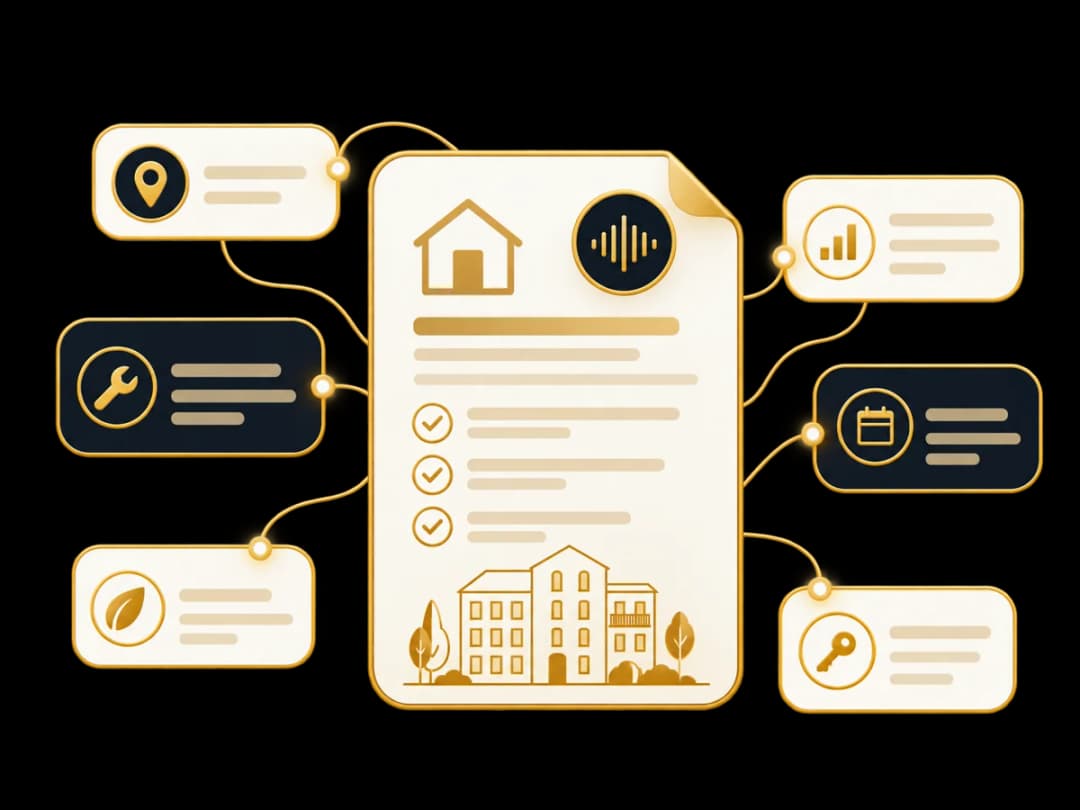
Whoever is looking for a flat asks the building. Whoever lived there passes on what they know. Both flow into the building’s property passport – which becomes more precise with every tenancy.
Check an address6 sections · approx. 4 min
Our mark

A house that speaks. And transparency for everyone who searches.
- The houseEvery address in Switzerland, with the official building data.
- The voiceWhat tenants experienced there – verified and without names.
- The magnifying glassStands for transparency: you find the voices before you sign.

In short
In three sentences
- You are looking: enter an address, read the property passport, ask better questions.
- You lived there: prove your tenancy and tell us in about ten minutes what you experienced.
- Every contribution is checked before it is published, and a number appears only from 3 tenancies.
You are looking
Ask the building before you sign. Three steps to better questions.
Enter an address – An address or the name of a property manager. Home-Voice knows every address in Switzerland from the official building register.
Read the property passport – Every building has a property passport. It shows what is known, what this knowledge is based on and when it dates from.
Ask better questions – Home-Voice does not replace the viewing. But you know what to ask about: the heating in January, footstep noise, the service charge statement, the defect that keeps coming back.
Nobody has shared anything yet? You still see the official facts about the building. And if you lived there, you can be the first voice.
The property passport
What the building is. What living there is like. What shows over time.
- The building
- Year of construction, floors, flats and heating from the official building register, plus public transport, noise and surroundings – for every building, even before anyone has shared anything. Every fact names its source.
- Living there
- A value from 0 to 100 with five stars, from five areas – flat, building, property management, costs and surroundings – with 17 topics. The number of tenancies is always shown next to it.
- The patterns
- Defects documented by tenants, with their status. A single incident stays a single incident; if the same problem returns over several tenancies, it becomes visible as a pattern.
- The development
- What was fixed, which renovations the property manager has proven, when the management changed – and what they say about it themselves.
Plus comments in people’s own words, checked before publication, and tools that fit the building.
The property passport does not decide whether a flat is good or bad. It shows experiences and connections. What matters to you is your decision.
You lived there
You hand back the keys. Not your knowledge.
Sign in – With your email address and a sign-in link. No password.
Enter the building and your tenancy – Which address, from when to when – or “I still live here” – and how you lived there. Which flat it was we only ask internally, so that a household counts once; this is never shown publicly. You confirm that you lived there yourself and do not own, look after or manage the building.
Prove your tenancy – Rental contract, service charge statement, handover report, electricity or internet bill. A person checks the document; then it is deleted, at the latest after 72 hours. No document to hand? You can add it within 30 days – until then nothing counts and nothing is published.
Tell us what you experienced – About ten minutes. We don’t ask “How did you like the flat?”, but for example: “How often was it too cold in winter even though the heating was on?” What doesn’t apply, we don’t ask; what you don’t know, you leave open. Everything is saved as you go, and you can stop at any time. The good counts too.
See what others see – Your answers only count together with others. You publish a comment and defects only if you want to. Before you submit, a preview shows you what others see – never your name, never your flat.
Checked and published – Every contribution is checked before it is published. We remove what breaks the rules – we never rewrite. Then the building has one more voice.
And afterwards
Your knowledge stays current.
- Document defects: With a complete review and proof, you record defects – where, what, since when, with photos and history. You keep the status up to date yourself. Home-Voice forwards nothing to the property manager; the tools help you report in writing yourself.
- Update: If you still live there, we invite you about once a year to confirm or refresh your answers.
- Correct: You can edit your review at any time. It is checked again; until then the previous version stays visible.
- Add your move-out: When you move out, you tell us how the handover and the deposit went – even later, if the deposit is still open.
Property managers
A good reply does not erase criticism. It completes the story.
Property managers who prove they are responsible can respond for free – to comments and defects. Every response is checked: factual, without tenants’ names. Private owners can respond, but never appear with their name. A response does not change a household’s experience after the fact.
What Home-Voice does not do
- No reporting channel. Home-Voice forwards nothing to the property manager.
- No legal advice. The tools give orientation. In a dispute, the tenants’ association or the conciliation authority can help.
- Nothing for sale. No good review bought, no unpleasant one negotiated away.
- No selling of data. We do not sell data about you. And we never pass on who you are – not to property managers either.